How to Lose Belly Fat at Home: What Actually Works

By Fernando Justo· October 27, 2026 · 10 min read
In this article
- How to lose belly fat at home, in short
- Why belly fat is the last to go
- The 80/20 rule: food does most of the work
- What changes on your plate: the 80%
- A workout to lose belly fat at home: the 20%
- Move all day: that’s where you burn the most
- Consistency and discipline: how not to give up
- Frequently asked questions
- Where to start
You can lose belly fat at home, but not the way most people think. Doing sit-ups every day won’t burn the fat on your belly. What works is three things together: eating a little less, training your whole body and moving more through the day, consistently.
The rule I follow is simple: losing belly fat is 80% food and 20% training. It isn’t exact math; it’s a way to get your priorities straight. The secret is to eat less and burn more, every day, for weeks, with discipline.
This guide explains why that rule works, with the data behind it, and shows what to do in each part: on your plate, in your workouts and in the rest of your day.
How to lose belly fat at home, in short
- Eat a little less than you burn, with real food as the base.
- Train your whole body 3 times a week, combining strength and cardio.
- Move all day: get up every hour or two.
- Measure your waist once a week, the same way each time.
- Think in weeks, not days: belly fat goes with consistency.
Why belly fat is the last to go
Sit-ups alone don’t burn belly fat
You can’t choose where your body burns fat from. In a study in the Journal of Strength and Conditioning Research, one group did seven abdominal exercises, five days a week, for six weeks, without changing their diet. Their ab endurance improved, but belly fat, waist circumference and body fat percentage didn’t change significantly.
Ab exercises strengthen the muscles, which is good for your posture and your back. But the fat on top of them only shrinks when your whole body uses more energy than it takes in.
Not all belly fat is the same
Some belly fat sits just under the skin. Some of it, visceral fat, sits deeper, around your organs, and it’s the kind that matters most for your health. The good news is that it responds to exercise: a meta-analysis in PLOS ONE, covering 15 studies and 852 people, found that exercise reduces visceral fat even without dieting, with the best results from moderate- to high-intensity aerobic exercise.
A tape measure is a simple way to keep track. According to a study in the BMJ that the World Health Organization’s thresholds are based on, a waist of 80 cm (31.5 in) or more for women and 94 cm (37 in) or more for men calls for attention, and from 88 cm (34.5 in) and 102 cm (40 in) it’s time to lose weight.
It’s a common problem. In Brazil, where I live, IBGE, the national statistics institute, found that 25.9% of adults were obese in 2019: 41.2 million people.
The 80/20 rule: food does most of the work
The research points the same way as the rule. A meta-analysis of 25 years of weight-loss studies compared diet, exercise and both together, in programs of about 15 weeks. With diet, or diet and exercise, people lost about 11 kg (24 lb). With exercise alone, about 3 kg (7 lb). A year later, those who combined both had kept more of the weight off.
Another review, of 80 trials lasting at least a year, reached the same conclusion: exercise alone led to very little weight loss, and the best results came from eating fewer calories, with exercise alongside.
In other words, you can’t out-train what you eat. But training isn’t a detail. It protects your muscles while you lose weight, helps you keep the weight off and, as we saw, goes after visceral fat. The 20% matters; it just can’t do the job on its own.
What changes on your plate: the 80%
You don’t need an extreme diet. You need to eat a little less, every day, and choose better. For a plan made for you, see a registered dietitian; the principles below work for almost everyone.
- Real food as the base. The golden rule of Brazil’s official Dietary Guidelines is to prefer natural or minimally processed foods, like rice, beans, vegetables, fruit, eggs and meat, and dishes made from them, over ultra-processed products.
- Fewer ultra-processed foods. In an NIH study, the same people ate about 500 calories more a day on an ultra-processed diet and gained about 0.9 kg (2 lb) in two weeks. In Brazil, ultra-processed foods already make up 19.7% of the calories people eat, according to a study in the Revista de Saúde Pública based on IBGE data.
- Watch the calories you drink. Soft drinks and other packaged drinks are ultra-processed too, and they add calories without filling you up.
- Slightly smaller portions. Making your plate a little smaller, without skipping meals, is easier to keep up than a strict diet.
- No rush. According to the CDC, people who lose weight gradually, about 1 to 2 pounds (0.5 to 1 kg) a week, are more likely to keep it off. And losing just 5% of your weight already helps improve blood pressure, cholesterol and blood sugar.
- Eat well around your workouts. A light snack before and a meal with protein after help you train better without going over your day’s calories. See what to eat before a workout and what to eat after a workout.
A workout to lose belly fat at home: the 20%
To lose belly fat, the best home workout isn’t an ab workout; it’s one that moves your whole body and gets you breathing hard. Combine strength, to keep and build muscle, with cardio and intervals, to burn more energy. Your abs work in almost all of these exercises.
Do this 20-minute workout three times a week, on alternate days. In the circuit, each exercise lasts 40 seconds, with 20 seconds of rest before the next one.
| Part | What to do | Time |
|---|---|---|
| Warm-up | March in place, step jacks, arm circles | 3 minutes |
| Circuit, 3 rounds | Jumping jacks · Squat · Mountain climber · Knee push-up | 12 minutes |
| Core | Plank (30 s) · Side plank (20 s each side) · Bicycle crunch (30 s) | 2 minutes |
| Stretch | Thighs, hips, chest and shoulders | 3 minutes |
If any of these exercises is new to you, my guide on how to exercise at home has step-by-step instructions for each, with an easier version.
On the other days, walk for 30 minutes. Together with the three workouts, that brings you close to the 150 to 300 minutes of activity a week that the World Health Organization recommends. When the circuit gets easy, go up to 4 rounds, add reverse lunges, or swap knee push-ups for full ones.
Move all day: that’s where you burn the most
To burn more calories, you have to be active, and not just while you train. An hour of exercise doesn’t make up for a whole day sitting still.
Researchers call this everyday energy use, outside exercise, NEAT: walking, standing, taking the stairs, doing chores. In a study in Science, people with obesity sat, on average, two hours longer a day than lean people. The authors estimated that with the lean group’s movement habits, they could burn about 350 more calories a day, with no extra workout.
In practice:
- Get up every hour or two and do a short set: a few squats, push-ups or a plank.
- Take calls standing or walking.
- Take the stairs, and walk to the shop.
- Take your work breaks away from your chair.
I go to the gym in the morning, but I spend the rest of the day working from home, and that’s where the risk is. So I do a short set every hour or two of work, and I wrote more about that habit in my guide to staying physically and mentally healthy when you work remotely.
MovePoints: an alternative for people who sit all day
If you don’t have time to train every day, or you spend hours in a chair, MovePoints is a good place to start. It’s an app I’m building to get people who sit all day moving: it sends short sets of push-ups, squats and other simple moves, under a minute each, between meetings. It connects to your work calendar, so it never interrupts you in the middle of a meeting.
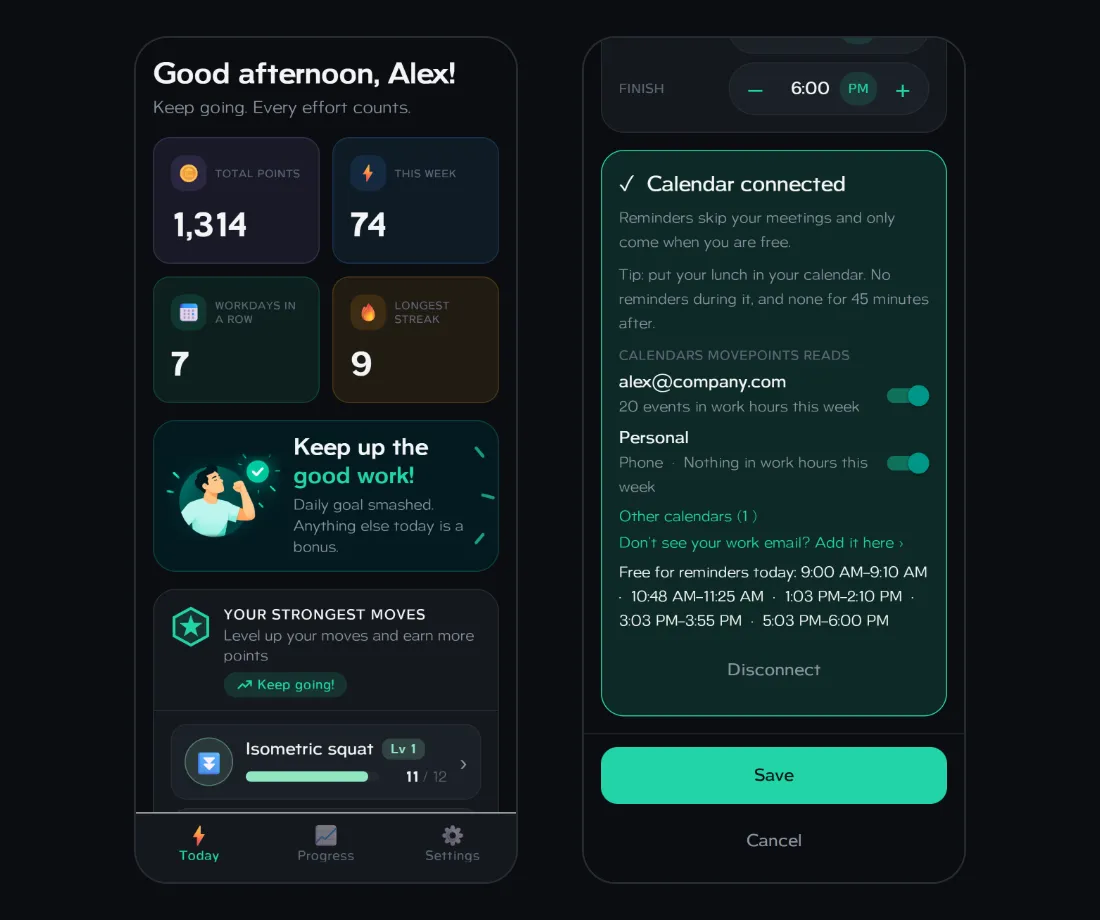
The Today screen, with points and streaks, and the connected calendar: reminders stay clear of your meetings.
Every set earns points and keeps your streak of workdays going, which helps with the hardest part of losing belly fat: consistency. It doesn’t replace your workouts or your diet; it adds movement to a day that would otherwise be still. MovePoints is in open testing on Android, so anyone can get MovePoints on Google Play. The iPhone version is coming soon.
Consistency and discipline: how not to give up
Belly fat doesn’t disappear in a week, and that’s when most people quit. A few things help you keep going:
- Measure your waist, not just your weight. Once a week, on the same day, in the morning, with the tape at your belly button. The scale shows your weight; the tape shows your belly.
- Plan your week. Put your three workouts in your calendar, like any other appointment.
- Don’t compensate. A day of overeating doesn’t call for a double workout the next day, or for giving up on the week. Get back on track at your next meal.
- Celebrate your streak. Counting the days in a row you trained or moved turns discipline into habit.
Frequently asked questions
What’s the best exercise to lose belly fat at home?
No exercise burns fat from your belly alone. The ones that help most move your whole body and get you breathing hard, like jumping jacks, mountain climbers, squats and lunges, done as a circuit. Planks and crunches strengthen your abs, but they don’t remove the fat on top of them.
Does working out at home help you lose weight?
It helps, but most weight loss comes from your diet. In the research, people who only exercised lost much less weight than those who cut calories. The best results come from both together, plus movement through the day.
Do sit-ups every day get rid of belly fat?
No. In the study above, six weeks of ab exercises, five days a week, improved ab endurance but didn’t reduce belly fat. Ab exercises build strength; what reduces fat is your whole body’s energy use, together with your diet.
How long does it take to lose belly fat?
It depends on how much you have to lose and how consistent you are. A healthy pace is about 1 to 2 pounds (0.5 to 1 kg) a week, according to the CDC, and a weekly tape measure shows whether your belly is shrinking. Think in months, not days.
Can you lose belly fat without a gym?
Yes. A gym helps, but it isn’t necessary: your diet, a home workout three times a week and more movement through the day do the job.
Is the workout to lose belly fat different for men and women?
The principles are the same for everyone: eat a little less, train your whole body and move more. What changes from person to person is the intensity, the reps and the starting point.
Where to start
Start this week with three changes: drop one ultra-processed food from your day, do the 20-minute workout three times, and get up from your chair every hour or two. Measure your waist today, and again a week from now.
If you’d like help moving during your workday, join the MovePoints test on Android.
This guide brings together guidelines and research. It doesn’t replace advice from a doctor, a registered dietitian or a qualified fitness professional.