How to Exercise at Home: A Beginner Workout With No Equipment

By Fernando Justo· October 24, 2026 · 12 min read
In this article
- How to exercise at home, in 5 steps
- How much exercise you need each week
- Before you start
- The 10 best exercises to do at home with no equipment
- A 20-minute beginner workout at home, with no equipment
- A weekly plan to get started
- How to progress without a gym
- Does working out at home help you lose weight? Can you lose belly fat at home?
- Short sets during the day count too
- Frequently asked questions
- Where to start
You can exercise at home with no equipment and very little space: your body weight, a mat and 20 minutes are enough to start. The hard part isn’t the workout; it’s knowing what to do, how much to do and how to progress without a coach next to you.
This guide answers those three questions. It covers the 10 exercises most worth doing at home, with step-by-step instructions and an easier version of each, a 20-minute beginner workout, a weekly plan, and what the research says about losing weight and belly fat by working out at home.
I go to the gym in the morning, but I spend the rest of the day working from home. During the workday, I do one or two short sets of exercise every hour or two, and this guide ends on that same idea: every move counts.
How to exercise at home, in 5 steps
- Clear a space of about 2 x 2 meters (6.5 x 6.5 feet) and grab a mat.
- Warm up for 5 minutes, marching in place and moving gently.
- Do a circuit of 4 to 6 bodyweight exercises, 2 to 3 rounds.
- Finish with 3 to 5 minutes of stretching.
- Repeat at least 3 times a week, and make it harder little by little.
How much exercise you need each week
The World Health Organization recommends 150 to 300 minutes of moderate to vigorous aerobic activity a week for every adult. The CDC adds at least 2 days of muscle-strengthening activity that works all the major muscle groups: legs, hips, back, abdomen, chest, shoulders and arms.
Most people don’t get there. In Brazil, where I live, the 2019 National Health Survey by IBGE, the national statistics institute, classified 40.3% of adults as insufficiently active: people who did no physical activity or less than 150 minutes a week, counting leisure, work and commuting.
The good news is that the WHO itself says physical activity of any type and any duration improves health, and more is always better. In practice, three 20-to-30-minute strength workouts at home plus two or three walks put you close to the target.
Before you start
- Talk to a professional if you need to. If you haven’t exercised in a long time, have a chronic condition or joint pain, or are pregnant, talk to a doctor or a qualified trainer first.
- Set up your space. A mat, sneakers or bare feet on a firm floor, a bottle of water and, for some exercises, a clear wall and a sturdy chair.
- Use what you have. Water bottles and a backpack full of books work as weights once an exercise gets easy.
- Form before numbers. Do fewer reps, done well. Tired, burning muscles are normal; sharp pain, or pain in a joint, means stop.
- Eat something light first. A banana 30 to 60 minutes before is enough energy. See the options in what to eat before a workout, and what to eat after a workout.
The 10 best exercises to do at home with no equipment
Together, these exercises work your whole body. Each one has an easier version to start with.
1. Squat
Works: thighs and glutes.
With your feet shoulder-width apart, lower yourself as if sitting into a chair, chest up and knees pointing the same way as your toes. Go as low as you can while keeping good form, then push through the floor to stand.
To start: sit down on a chair and stand up again without using your hands. Set: 10 to 15 reps.
2. Push-up
Works: chest, shoulders and triceps.
Put your hands on the floor slightly wider than your shoulders, body straight from head to heels. Lower your chest close to the floor and push back up.
To start: keep your knees on the floor, or do the push-up with your hands on a wall or a sturdy table. Set: 6 to 10 reps.
3. Lunge
Works: thighs, glutes and balance.
Take a long step forward or backward and lower yourself until both knees are bent at about 90 degrees. Push back to standing and switch legs.
To start: step backward (a reverse lunge), which is easier on the knees, and keep a hand on the wall. Set: 8 to 10 reps per leg.
4. Glute bridge
Works: glutes, hamstrings and lower back.
Lie on your back with your knees bent and feet on the floor. Lift your hips until your body forms a straight line from shoulders to knees, hold for two seconds and lower slowly.
To start: lift only as high as feels comfortable. Set: 12 to 15 reps.
5. Plank
Works: abs and your whole core.
Rest on your forearms and toes with your body straight. Brace your abs and glutes and breathe normally, without letting your hips sag.
To start: keep your knees on the floor. Set: 20 to 30 seconds, building up to 60.
6. Jumping jacks
Works: cardiovascular fitness and your whole body.
Jump while spreading your legs and raising your arms, then jump back. Keep a pace that still lets you breathe.
To start: skip the jump, stepping one leg out at a time as you raise your arms. Set: 30 to 45 seconds.
7. Wall sit
Works: thighs.
Lean your back against a wall and slide down until your knees are bent at about 90 degrees, as if sitting on an invisible chair. Hold.
To start: don’t go as low. Set: 20 to 40 seconds.
8. Calf raise
Works: calves and ankles.
Standing, with a hand on the wall for balance, rise onto your toes, hold for a second and lower slowly.
To start: keep both hands on the wall. Set: 15 to 20 reps.
9. Chair dip
Works: triceps and shoulders.
Push a sturdy chair against a wall. Sit on the edge, put your hands next to your hips and slide your hips off the seat. Bend your elbows to lower yourself and straighten them to come up.
To start: keep your knees bent and your feet close to the chair. Set: 8 to 12 reps.
10. Mountain climber
Works: abs and conditioning.
In a push-up position with your arms straight, bring one knee toward your chest, then the other, alternating at a steady pace.
To start: go slowly, or put your hands on a step or a sturdy sofa. Set: 20 to 30 seconds.
A 20-minute beginner workout at home, with no equipment
Do this workout three times a week, on alternate days. Rest about a minute between rounds.
| Part | What to do | Time |
|---|---|---|
| Warm-up | March in place, step jacks, arm and hip circles | 5 minutes |
| Circuit, 3 rounds | Squat (12) · Knee push-up (8) · Glute bridge (12) · Plank (20 to 30 s) · Jumping jacks (30 s) | 12 to 14 minutes |
| Stretch | Thighs, hamstrings, chest and shoulders, 20 to 30 seconds each | 3 to 5 minutes |
For variety, swap in this circuit, which works other muscles: reverse lunge (8 per leg), chair dip (10), wall sit (30 s), calf raise (15) and mountain climber (20 s).
A weekly plan to get started
| Day | Activity |
|---|---|
| Monday | 20-minute workout (circuit 1) |
| Tuesday | A walk or other light cardio, 30 minutes |
| Wednesday | 20-minute workout (circuit 2) |
| Thursday | Active rest: stretching or an easy walk |
| Friday | 20-minute workout (circuit 1) |
| Saturday | Anything you enjoy: cycling, dancing, a sport or a hike, 30 to 60 minutes |
| Sunday | Rest |
The workouts and cardio add up to 120 to 150 minutes a week. Add everyday walking and short sets during the workday and you reach the WHO’s 150 minutes, with three strength days, one more than the minimum.
How to progress without a gym
Your body adapts. When the last reps start to feel easy, change one thing at a time, every week or two:
- More reps: add 2 or 3 per exercise.
- More rounds: go from 3 to 4 rounds of the circuit.
- Slower: take three seconds on the way down, so the muscle works longer.
- A harder version: swap knee push-ups for full push-ups, or the plank for a plank with shoulder taps.
- More weight: hold water bottles, or wear a backpack full of books, for squats and lunges.
Write down what you did in each workout. Watching the numbers go up is one of the best reasons to keep going.
Does working out at home help you lose weight? Can you lose belly fat at home?
It helps. Working out at home burns calories and builds muscle, and combining strength and cardio is the most complete approach. But for weight loss, exercise works together with what you eat and how you sleep, not on its own.
And you can’t burn fat from one spot. In a study in the Journal of Strength and Conditioning Research, one group did seven abdominal exercises, five days a week, for six weeks, without changing their diet. Their ab endurance improved, but belly fat, waist circumference and body fat percentage didn’t change significantly. To lose belly fat, train your whole body, look after your diet and stay consistent. I explain how, step by step, in my guide on how to lose belly fat at home.
Short sets during the day count too
Not every bit of exercise has to be a workout. A study in Nature Medicine followed 25,241 adults who didn’t exercise, wearing wrist sensors, for almost seven years. Those with about three short bursts of vigorous activity a day, of one or two minutes each, like taking the stairs fast, had a 38% to 40% lower risk of death and a 48% to 49% lower risk of death from cardiovascular disease than those with none. It’s an observational study, so it shows an association rather than proof of cause, but it points the same way as the WHO: every move counts.
That’s why I do a short set every hour or two of work: a few squats, push-ups or a plank, in under a minute. I wrote more about that habit in my guide to staying physically and mentally healthy when you work remotely.
To remember my sets, I use MovePoints, an app I’m building to get people who sit all day moving. It sends short sets of push-ups, squats and other simple moves between meetings, and shows you how long to hold the static ones, like the plank.
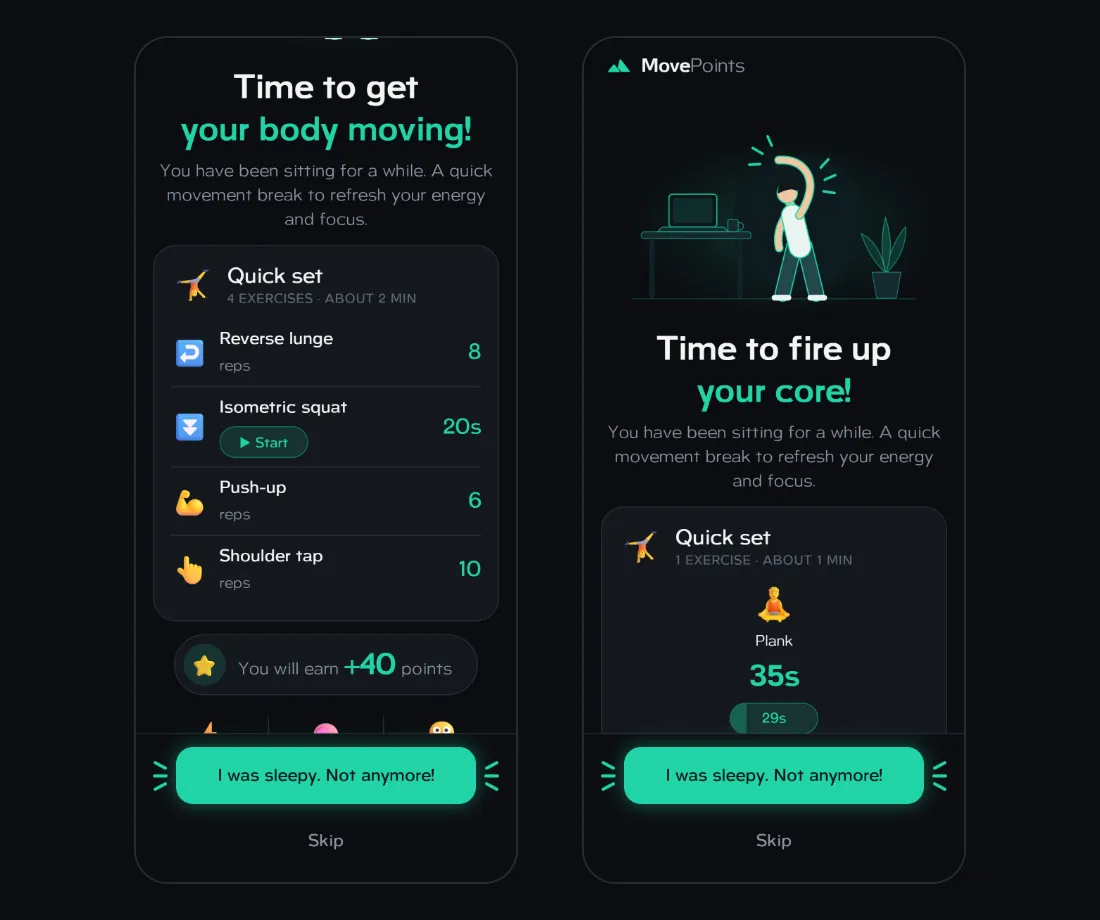
A quick set in MovePoints, with four exercises in about two minutes, and the plank timer. App screens with a sample plan.
It connects to your work calendar, so reminders only arrive when you’re free, never in the middle of a meeting. Every set earns points and keeps your streak of workdays going. It doesn’t replace your workouts; it’s a partner to them, and it keeps you moving on the days you can’t train.
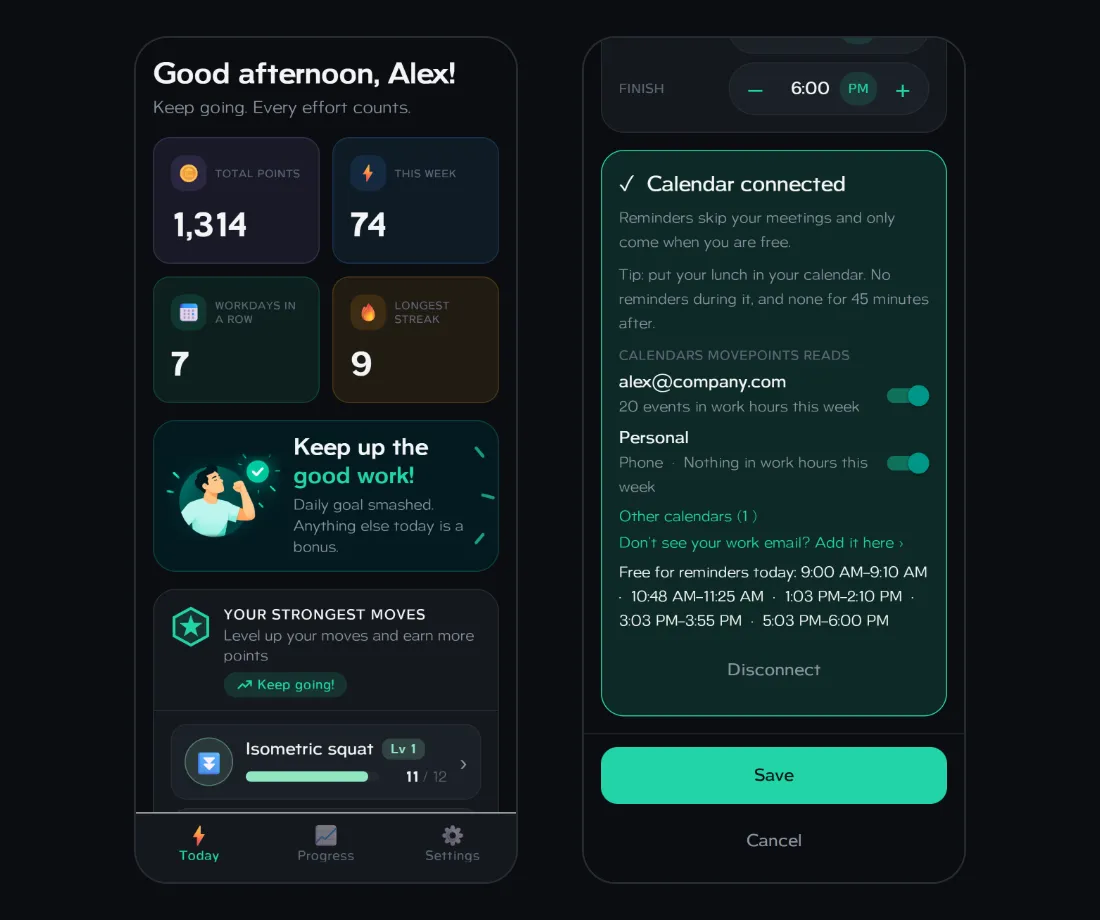
The Today screen, with points and streaks, and the connected calendar: reminders stay clear of your meetings.
MovePoints is in open testing on Android, so anyone can get MovePoints on Google Play. The iPhone version is coming soon.
Frequently asked questions
What are 5 exercises I can do at home?
Squats, push-ups, lunges, glute bridges and planks. Together, they work your legs, glutes, chest, arms and abs, with no equipment at all. Do 2 to 3 rounds of 10 to 15 reps each, or 20 to 30 seconds for the plank.
What are 20 exercises I can do at home?
- Squat
- Push-up
- Lunge
- Glute bridge
- Plank
- Jumping jacks
- Wall sit
- Calf raise
- Chair dip
- Mountain climber
- Sumo squat, with your feet wider apart
- Side lunge
- Side plank
- Plank with shoulder taps
- Crunch
- Bicycle crunch
- Superman, lying face down and lifting your arms and legs
- High knees, running in place
- Jump squat
- Burpee
The first ten are explained above. The last few, like jump squats and burpees, are more intense: save them for when the beginner workout feels easy.
What happens if I work out at home every day?
Moving every day is good for you: walks, stretching and short sets can be daily. Harder strength workouts, though, pay off more with a break between them, which is why the plan above alternates two circuits and keeps rest days. If you notice pain that doesn’t go away, constant tiredness or worse sleep, ease off.
What’s the best physical activity to do at home?
The one you’ll keep doing. Ideally, combine strength exercises, at least twice a week, with aerobic activity, and a circuit like the one in this guide does both at once. For variety, dancing, yoga and jumping rope also work in a small space.
Does working out at home help you lose weight?
It helps, as long as it comes with a balanced diet and consistency. Exercise burns calories and builds muscle, but it doesn’t burn fat from one specific spot, like your belly.
Where to start
Start today with three exercises: squats, wall push-ups and a plank. Do two rounds, in about 10 minutes. Next week, move on to the 20-minute workout, and follow the weekly plan.
If you’d like help moving during your workday too, join the MovePoints test on Android.
This guide brings together guidelines and research. It doesn’t replace advice from a doctor or a qualified fitness professional.